Welcome to the Family History Social

The very latest news from the world of genealogy

Categories

More...

TheGenealogist launches Sussex Lloyd George Domesday, in partnership with The National Archives

Available online for the first time, discover properties, owners and occupiers across Sussex, with linked books and maps

TheGenealogist today announces the release of Sussex Lloyd George records in partnership with The National Archives, bringing together the Valuation Office Survey field books (“Lloyd George Domesday”) and georeferenced historical maps for Sussex in a single, searchable resource.

This significant addition allows family and local historians to pinpoint where ancestors lived or owned property in Sussex in the early 1910s, then click straight through to the corresponding survey book entry for details such as ownership/occupancy, property description and assessed value.


Bateman’s Kiplings Sussex Home

What’s included

  • 269,211 Occupiers, Owners & Organisation

  • Georeferenced historical maps that link properties to the exact location on the ground

  • Owner and occupier details, addresses, plot numbers and descriptive notes (where recorded)

  • Map-to-book and book-to-map links for seamless research across records

Among the newly released entries is Rudyard Kipling, whose Sussex home appears in the records. To mark the launch, TheGenealogist has published an accompanying feature article exploring Kipling’s connection to the county and how these records illuminate his footprint in Sussex.

From the Downs to the Weald, this addition reveals Sussex in remarkable detail. You can explore a county of independent smallholders, traders, and householders rooted to their place.” said Mark Bayley, Head of Content at TheGenealogist.

Working with The National Archives, TheGenealogist continues to expand access to this landmark property survey for England and Wales, rolling out county coverage with both digitised books and linked, layered maps.

Why this matters

  • Place your ancestors on the map: Identify the precise plots where families lived or held property.

  • Context at a glance: Understand neighbourhoods, land use and changing streetscapes in the years just before the First World War.

  • One-click discovery: Move effortlessly between a mapped property and details of the owner and occupier.


The Sussex Lloyd George records are available now to TheGenealogist’s Diamond subscribers.


Don’t miss out!

For a limited time, you can subscribe to TheGenealogist for just £118.95

Not only will you get a lifetime discount, but you'll also receive a 12-Month Subscription to Discover Your Ancestors Online Magazine - a total saving of over £75!

Explore these new records and start your genealogical journey today with TheGenealogist by claiming this offer here: https://www.thegenealogist.co.uk/MGBLGD925


Offer expires 31st December 2025.  
Leave a comment

Discovering Ancestors with the Lloyd George Domesday Survey: A Hidden Gem for Family Historians

When tracing the lives of our ancestors, we often turn to the usual records – censuses, parish registers, and civil registrations. But sometimes the really fascinating details come from less well-known sources. One such treasure trove is the Lloyd George Domesday Survey, an extraordinary record set that offers a detailed look at who lived where and how land was used in the early 20th century. If you’re researching ancestors from this period, it’s well worth exploring.

What is the Lloyd George Domesday Survey?

The Lloyd George Domesday Survey was a nationwide valuation of land and property across England and Wales carried out between 1910 and 1915. It was part of a much bigger project set up by David Lloyd George when he was Chancellor of the Exchequer.

The idea behind it was to introduce a new tax on land, and to do that fairly, the government needed a detailed picture of land ownership and usage. What this means for us today is a remarkable collection of maps, field books, and notes that record:

  • Who owned each piece of land

  • Who occupied the land

  • What type of buildings were on the land

  • How the land was used

  • The value of the land and buildings

All this information was recorded at a time when many people were still living in the homes they had grown up in or had only just moved out. It offers a unique snapshot of British society just before the First World War.

Why Is It Useful for Family Historians?

For anyone tracing their family history, the Lloyd George Domesday Survey is like finding a photograph of your ancestor’s street – but with extra details that even a photo couldn’t show. Here’s why it’s so valuable:

1. You Can Pinpoint Exact Addresses

If you’ve found your ancestor on the 1911 Census, the Domesday Survey can help you go a step further. It ties names and addresses to specific plots on maps, letting you see exactly where someone lived. Not just the street – the exact building or piece of land.

2. It Connects People to Properties

Unlike the census, which only shows residents, the Domesday Survey also records owners. This can be incredibly helpful if your ancestors were landlords, tenants, or landowners. It may reveal relationships and business connections that aren’t obvious elsewhere.

3. You Learn About the Property Itself

Want to know what kind of house your ancestor lived in? The field books describe the property in detail – number of rooms, type of building, whether there was a garden or yard, and sometimes even comments about condition or improvements. It’s a real glimpse into everyday life.

4. It Bridges the Gap Between Censuses

There’s a long gap between the 1911 and 1921 censuses, and the 1939 Register is still a couple of decades later. The Lloyd George Domesday Survey sits neatly between them, helping to track people or places during that in-between period.

5. It Helps You Reconstruct a Whole Community

Because it covers entire areas, not just individuals, you can use it to rebuild your ancestor’s neighbourhood. You’ll see who lived next door, who owned the shop on the corner, and what land was used for farming or industry. It gives context that brings your research to life.

Where Can You Find It?

The original records are held at The National Archives, and TheGenealogist is well under way at digitising and publishing the collection. Accessing them online is through TheGenealogist, which links to their powerful MapExplorer tools. These allow you to click on a modern map and peel back the layers to see what was there in 1910.

You can search by name, street, or area and then view:

  • The original hand-anotated maps (based on Ordnance Survey)

  • The accompanying field books with details of the property and ownership

A Case in Point

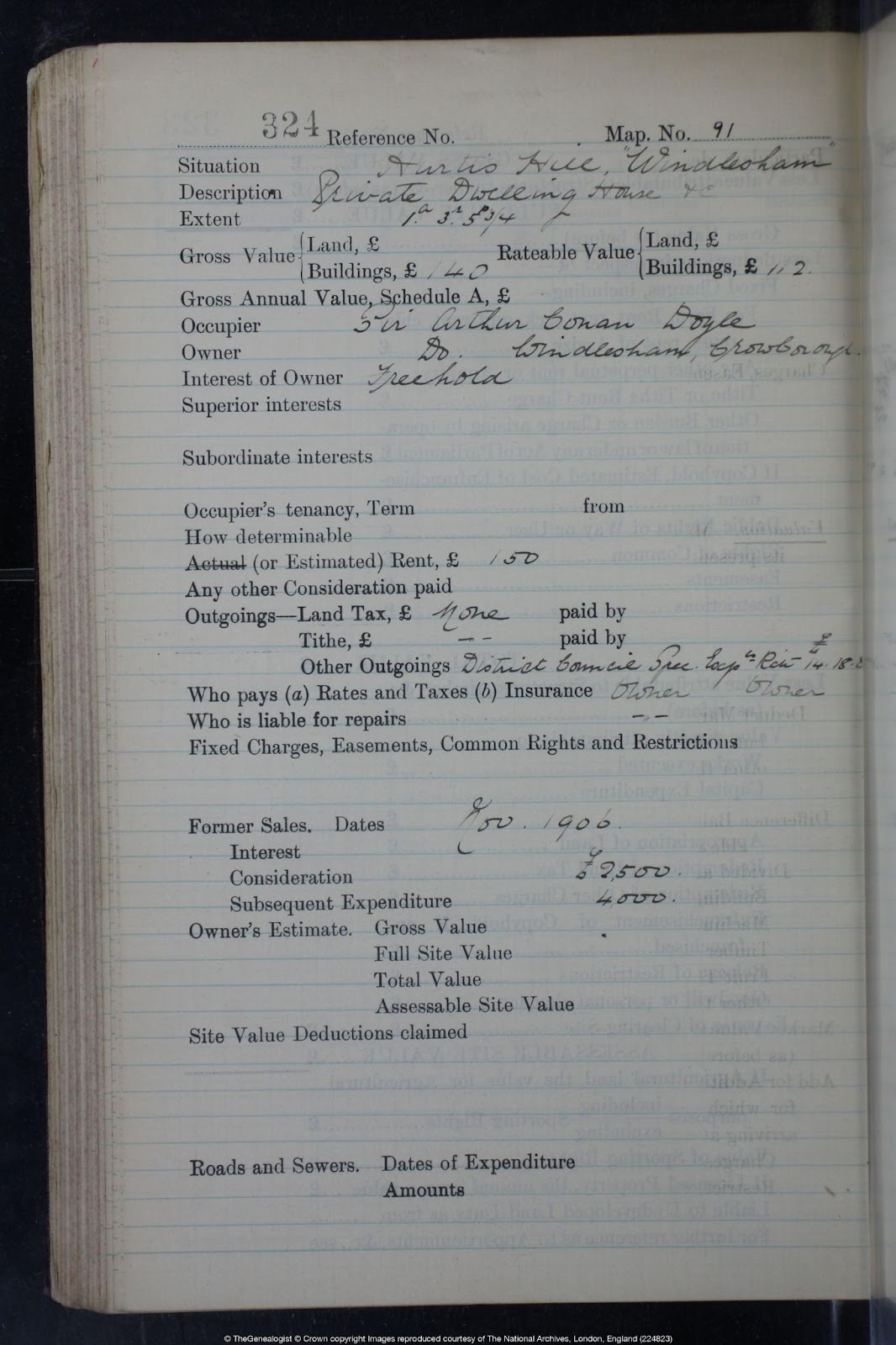
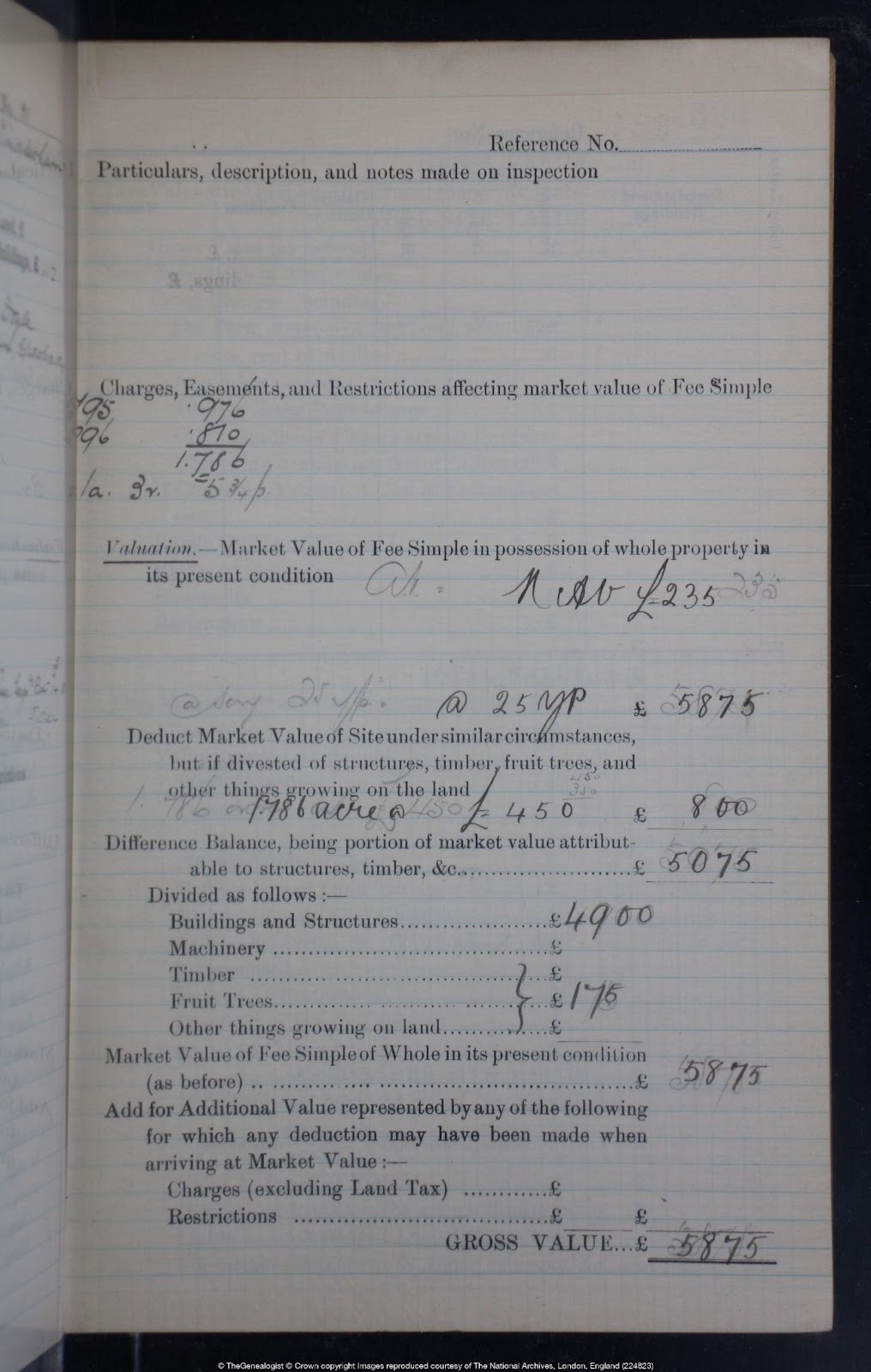
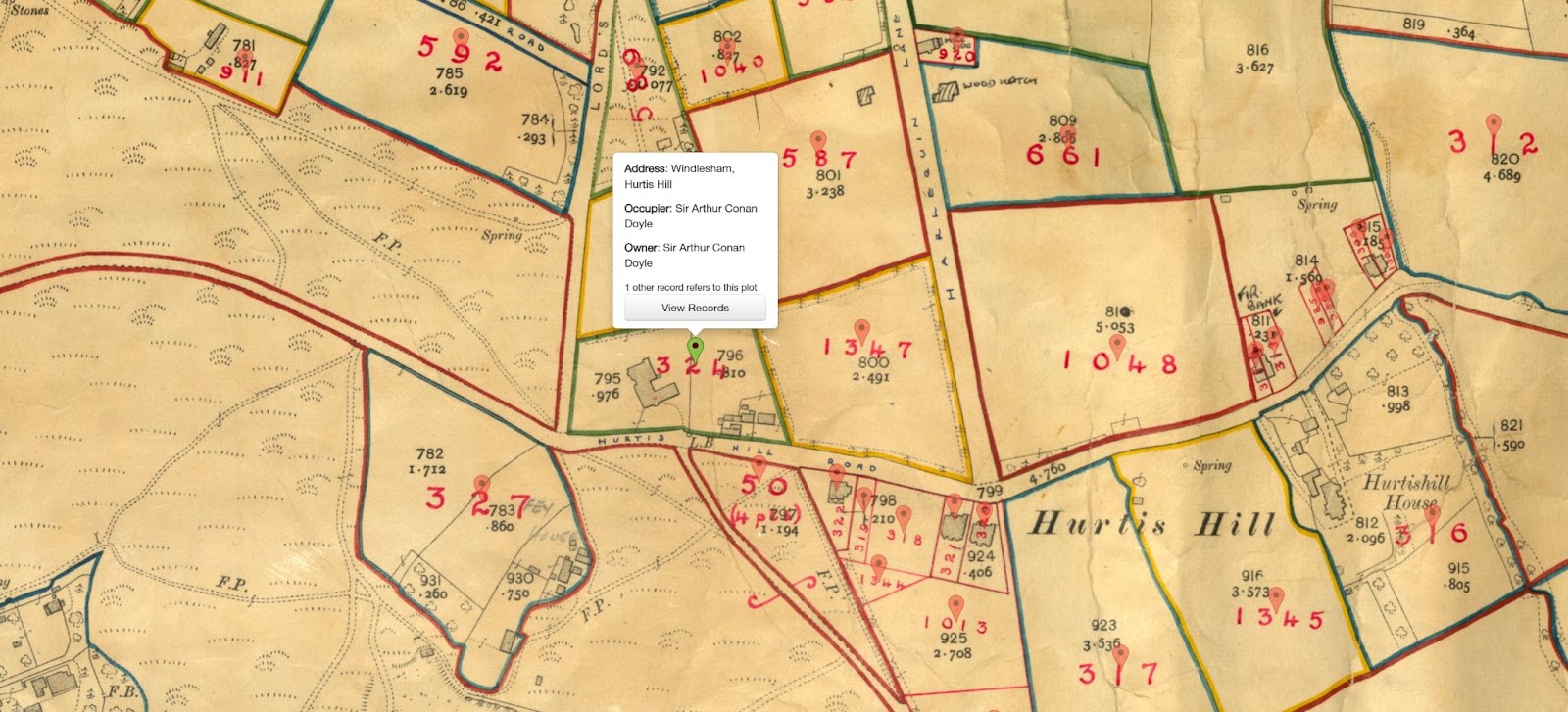
Let’s look for Sir Arthur Conan Doyle, who lived in Crowborough in 1911. By looking him up in the Lloyd George records, we discover he owned ‘Windlesham’ on Hurtis Hill. You might even find notes about the house having a small workshop attached – something that doesn’t appear on the census.

If you’re lucky, the field book might mention improvements made to the house, changes in tenancy, or even a description of the garden. Suddenly, you’re not just looking at a name on a census return – you’re starting to picture the home and the life your ancestor lived.

Final Thoughts

The Lloyd George Domesday Survey is still an underused source in family history research – but it’s a gem for those who take the time to explore it. With its rich detail and precise mapping, it lets you connect names, places, and properties in a way that few other records can.

If you’re looking to add depth and colour to your family story, especially around the turn of the 20th century, this is a brilliant tool to add to your kit.


Want to explore the Lloyd George Domesday Survey for yourself? You can find many of the digitised records at TheGenealogist.co.uk with MapExplorer tools to help you get started.

Leave a comment

TheGenealogist Releases Lloyd George Domesday Records for Cambridgeshire

Leading family history website TheGenealogist is delighted to announce the release of the Lloyd George Domesday Survey records for Cambridgeshire. This exciting addition offers researchers a detailed view of land and property ownership and occupancy.

The records give information about the person living at an address and the type of property they had. Details within the field books can include plans and detailed descriptions of properties that provide a unique snapshot of local communities during a period of significant social change.

The Lloyd George Domesday Survey was carried out between 1910 and 1915 to create a comprehensive record for tax purposes. The newly released Cambridgeshire records link rich field books and large-scale hand-annotated Ordnance Survey maps, allowing users to pinpoint exactly where ancestors lived, what land they owned or occupied, and details about the properties themselves.

This latest release includes:

  • 164,524 individuals and businesses pinned to maps on MapExplorerTM

  • Covering over 1,000 square miles

  • Searchable field book entries naming owners and occupiers

  • Precise property descriptions including size, usage, and value

  • Detailed mapping of each property using contemporary Ordnance Survey maps


Eglantyne Jebb, Founder of Save the Children, can be found in these new records

Mark Bayley, Head of Online Content at TheGenealogist, said:
"We are thrilled to add Cambridgeshire to our growing collection of Lloyd George Domesday records. For anyone with roots in the county, this is an incredible resource to find exactly where their ancestors lived and to uncover stories about the land they occupied."

Within these records can be found the Ball family, who set up an industry overnight, discovering that the old adage “Where there’s muck, there’s money” rings true! Discover more about the family and their unusual trade in Coprolite in our latest article, “Burwell’s Surprising Buried Treasure”.


The Lloyd George Domesday records are available to Diamond subscribers of TheGenealogist.

Leave a comment

TheGenealogist Releases Over 350,000 Lloyd George Domesday Survey Records for Essex

Comprehensive collection offers unprecedented access to early 20th-century property records across 1,400 square miles

TheGenealogist has announced the release of the Lloyd George Domesday Survey for Essex, a significant addition to its growing collection of historical property records. This extensive dataset contains 356,265 records of occupiers, owners and organisations, all meticulously pinned to annotated maps.

This brings the total coverage of the Lloyd George Domesday Survey to over 11,000 square miles, exclusive to TheGenealogist!

Named after David Lloyd George, the Chancellor of the Exchequer responsible for the 1910 Finance Act, the Lloyd George Domesday Survey was a comprehensive land valuation of England and Wales. The resulting records offer genealogists and historians an invaluable insight into property ownership and occupation in the early 20th century.


The Lloyd George Domesday Survey Map for Maldon, Essex

"From the coastline, the countryside and up to the capital, these records provide an invaluable resource for those researching family and social history in Essex," said Mark Bayley head of online content at TheGenealogist. "By combining detailed records with precise geographical data, Map Explorer enables researchers to visualise exactly where their ancestors lived and understand the area they called home."


The collection features:

  • 356,265 individual records of property occupiers, owners, and organisations

  • Annotated maps covering 1,400 square miles of Essex

  • Detailed property descriptions and valuations

  • Names and addresses of both owners and occupiers

This release forms part of TheGenealogist's ongoing commitment to digitising and preserving these historically significant records. The Lloyd George Domesday Survey is particularly valuable as it records the exact locations of properties, making these property records an essential source for genealogical, social and historical research.

Researchers can access the Lloyd George Domesday Survey records for Essex through TheGenealogist's Diamond Subscription, where they can be searched by name, address, or through MapExplorerTM, allowing for precise research across this historic county.

For more information about TheGenealogist's Lloyd George Domesday Record Collection or to begin searching these records, visit: https://www.thegenealogist.co.uk/1910/

The Courtauld family, one of Britain’s greatest industrial success stories can be found in this release - read their story here: https://www.thegenealogist.co.uk/featuredarticles/2025/courtaulds-a-crape-british-industry-8018/

Leave a comment

TheGenealogist Unveils 1910 Lloyd George Domesday Records for Wiltshire

Pinpoint your ancestors' property in 1,346 square miles of the South West of England.

TheGenealogist, a leading UK family history website, has announced a significant addition to its collection of historical records. The website has released the 1910 Lloyd George Domesday records and geolocated maps for the entire county of Wiltshire, covering an impressive 1,346 square miles and containing information on more than 175,000 individuals and organisations.


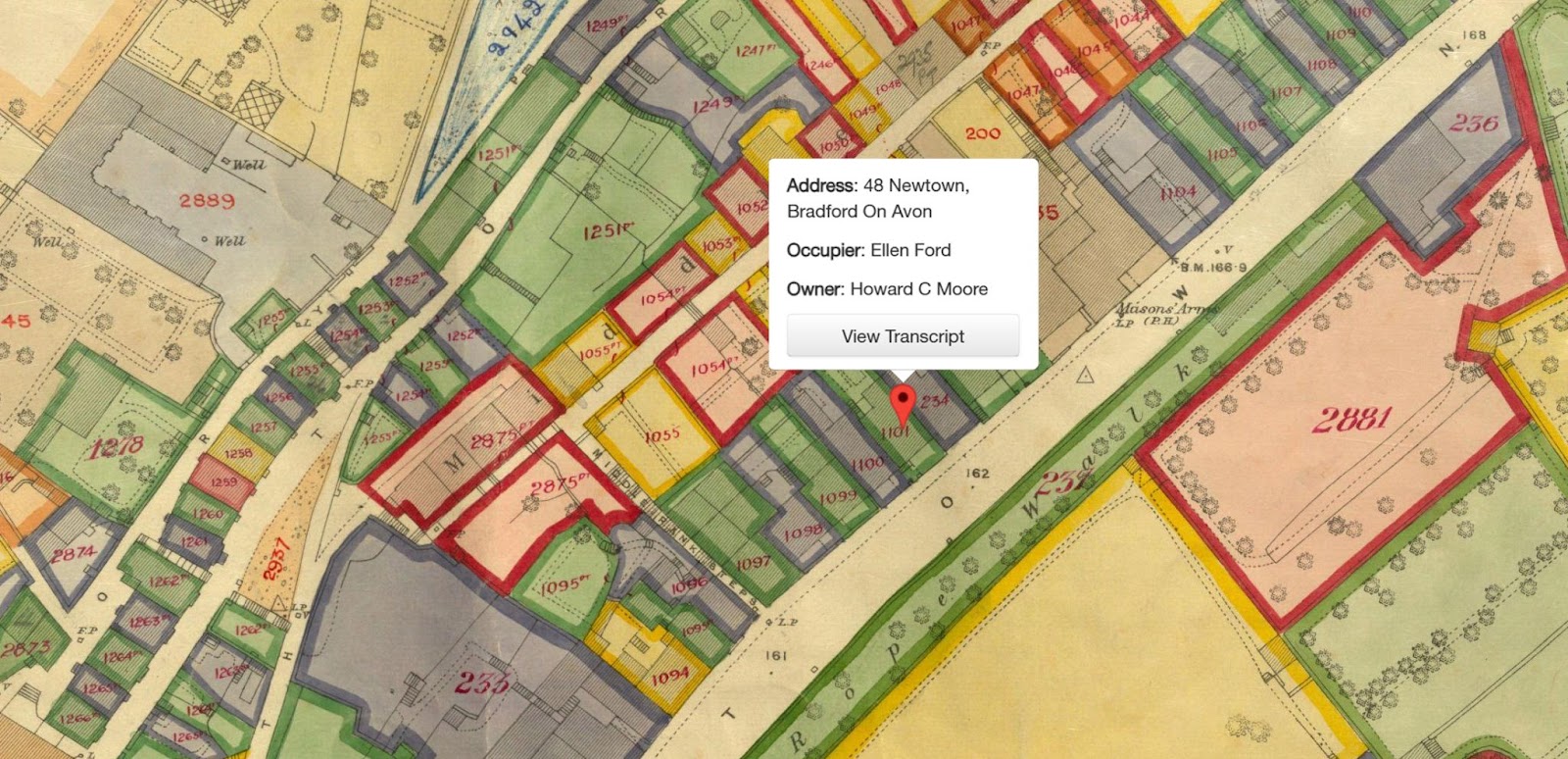
Bradford on Avon in TheGenealogist’s Lloyd George Domesday Survey

Key Highlights:

  • Comprehensive Coverage: The release encompasses the whole of Wiltshire, providing researchers with access to a wealth of genealogical and historical data.


  • Geolocated Maps: Advanced mapping technology allows users to pinpoint the exact locations of ancestral properties and landmarks.


  • Over 175,000 Names: A treasure trove of information for family historians and researchers interested in early 20th-century Wiltshire.


  • Historical Significance: The Lloyd George Domesday records offer unique insights into property ownership and land use in Edwardian England.


Mark Bayley, Head of Online Development at TheGenealogist, stated, "This release of the 1910 Lloyd George Domesday records for Wiltshire is a game-changer for those researching family, local and social history in the county. The combination of detailed records and geolocated maps provides an unprecedented level of insight into the lives of Wiltshire residents at the turn of the 20th century."


The Lloyd George Domesday records, also known as the 1910 Valuation Office Survey records, were created to assess property values for tax purposes. They offer a snapshot of land ownership and occupation just before the outbreak of World War I, making them an invaluable resource for genealogists and historians alike.


Researchers can now:

  • Locate ancestral homes and businesses with precision

  • Discover details about the area their ancestors lived in, such as locating their local school, church or pub

  • Gain insights into the social and economic conditions of Edwardian Wiltshire

  • Cross-reference information with other historical records for a more complete family history


This release is part of TheGenealogist's ongoing commitment to providing the most comprehensive and user-friendly resources for family history research. They plan to continue expanding their collection of Lloyd George Domesday records to cover more counties in the coming months.


For more information about the 1910 Lloyd George Domesday records, visit https://www.thegenealogist.co.uk/lloyd-george-domesday/.


Read the feature article ‘The Saga of Stonehenge’ at TheGenealogist here:

https://www.thegenealogist.co.uk/featuredarticles/2024/the-saga-of-stonehenge-7660/ 


To celebrate this release, for a limited time, you can claim a Diamond Subscription for just £94.95, a saving of £45. You can claim this offer here:


https://www.thegenealogist.co.uk/TNALGD924

Leave a comment

TheGenealogist expands its Landowner Records Collection with their latest release

TheGenealogist is excited to announce the release of nearly 300,000 historic landowner records. The new additions consist of Feet of Fines, Index of Sasines, and the Scotland Record Office Index to Register of Deeds, offering a wealth of information for those delving into their ancestry.


Feet of Fines: These documents provide insights into land transactions, usually involving the transfer of property rights, and were commonly used in English legal proceedings from the 13th century onwards. The Feet of Fines contains detailed information about the parties involved in the transactions, property descriptions, and the dates of agreements, serving as a vital resource for researchers tracing their family land ownership or exploring the economic history of a region.


Index of Sasines: The release of the Index of Sasines marks a significant addition to TheGenealogist's Scottish records. Sasines are legal documents that confirm the possession of land and property, reflecting the transfer of ownership in Scotland from the 16th century onwards. This index allows users to quickly locate and access critical details surrounding property ownership, making it an essential tool for genealogists looking to understand their ancestral ties to land in Scotland.


Scotland Record Office Index to Register of Deeds: This comprehensive index opens the door to a vast array of legal documents relating to property and inheritance in Scotland. By providing easy access to this substantial resource, TheGenealogist allows users to uncover their family histories and gain a deeper understanding of the social and legal contexts in which their ancestors lived.


These new records are now available on TheGenealogist, providing an unparalleled opportunity for researchers to deepen their exploration of family histories and connect with their pasts.


In this release are: Berwick, Index to Register of Sasines Volume I. A-H 1617-1780; London and Middlesex, A Calendar to the Feet of Fines 1179 - 1485; Yorkshire Feet of Fines 1327-1614; Huntingdon Calendar of the Feet of Fines 1194-1603; Scotland, Index to Particular Register of Sasines for Sheriffdom of Dumfries and Stewaertries of Kirkcudbright and Annandale 1617 - 1732; 

Scotland Record Office, Index to Register of Deeds, 1661 - 1679


Read the feature article ‘The Scottish Rebel Who Defied the Crown: Andrew Fletcher's Fight for Independence’ at TheGenealogist here:

https://www.thegenealogist.co.uk/featuredarticles/2024/the-scottish-rebel-who-defied-the-crown-7584/ 


To celebrate this release you can Save Over £50 on our Diamond Package here: https://www.thegenealogist.co.uk/affiliate/?affid=lzupkh&page=2723

Leave a comment

Historic Records and Maps for Oxfordshire Launched Online

Over 1,000 square miles of searchable property records have been released


Today sees the launch of a superb new resource for family historians, providing a great way to discover what type of property our ancestors once occupied. TheGenealogist has just added records covering every head of household and property owner in Oxfordshire around the period 1910-1915 with their latest release. Known as the Lloyd George Domesday Survey, the site now has over 2 Million records searchable online from this collection, covering all boroughs of Greater London plus Middlesex, Buckinghamshire, Berkshire and West Hertfordshire, along with the newly added Oxfordshire.


High Street, Oxford TheGenealogist’s Image Archive


The records were created when one of the most important government surveys took place in Britain as a result of David Lloyd George’s 1910 Finance Act. The Board of Inland Revenue Valuation Office Survey, or The Lloyd George Domesday Survey as the records have become known, is safely held by The National Archives at Kew. 


Following many years of collaboration between The National Archives’ conservation and records team and TheGenealogist’s digitization staff at Kew, the project to publish these records, comprising of the IR 58 Field Books and accompanying IR 121 to IR 135 Ordnance Survey maps, has now reached a major landmark.


This latest release of Oxfordshire records from The National Archives joins the millions of records in TheGenealogist’s powerful tool, Map Explorer™.


  • The Lloyd George Domesday Survey identifies individual properties on extremely detailed 1910-1915 maps, zoomable to the exact plot
  • The surveyors’ field books provide fascinating details about the house, often revealing the size and number of its rooms
  • Maps reveal the features of the neighbourhood in which an ancestor lived
  • Search using the Master Search or by clicking on the pins displayed on TheGenealogist’s powerful Map Explorer™ 
  • Historic maps are layered over modern street maps, allowing you to see how an area changed over time
  • The project will expand to cover the rest of England & Wales


Dr Jessamy Carlson, Family & Local History Engagement Lead at The National Archives, said:

“The Valuation Office maps are a key resource for house and local history, and this project is an exciting development for future research. Oxfordshire is an excellent addition to this growing set of online resources, and the variety of residences it covers reveals some fascinating insights into communities before the First World War.”


Mark Bayley, Head of Online Content at TheGenealogist, said:

“This release marks a major milestone in the Lloyd George Domesday Project, with now over 2 Million records available for family historians to search. These records enable genealogists and researchers to gain insights and reveal the intricacies of our ancestors' homes, gardens and property ownership.”


Oxfordshire is the latest release of TheGenealogist’s Lloyd George Domesday Records


Visit thegenealogist.co.uk/1910Survey for more information.


Read TheGenealogist’s article in which these records were used to find the property of Oxford resident William Morris: The Cyclist Champion who built a Car Empire

https://www.thegenealogist.co.uk/featuredarticles/2023/the-cyclist-champion-who-built-a-car-empire-3795/


About TheGenealogist

TheGenealogist is an award-winning online family history website, which puts a wealth of information at the fingertips of family historians. Their approach is to bring hard to use physical records to life online with easy to use interfaces such as their Tithe and newly released Lloyd George Domesday collections. 

TheGenealogist’s innovative SmartSearch technology links records together to help you find your ancestors more easily. TheGenealogist is one of the leading providers of online family history records. Along with the standard Birth, Marriage, Death and Census records, they also have significant collections of Parish and Nonconformist records, PCC Will Records, Irish Records, Military records, Occupations and Newspaper record collections amongst many others.

TheGenealogist uses the latest technology to help you bring your family history to life. Use TheGenealogist to find your ancestors today!

Leave a comment

Borough of Hackney Lloyd George Domesday records added to TheGenealogist’s Map Explorer™


TheGenealogist has just released the Hackney maps and field books into its property ownership and occupancy record set, The Lloyd George Domesday Survey. Family historians can use this unique online resource to see where an ancestor lived in the 1910-1915 period for a number of areas and will extend out across the country in time.


These records make use of TheGenealogist’s powerful new Map Explorer to access the maps and residential data, so that those who want to discover where their ancestors lived in the period before the First World War are able to see the district as it was in that period. Because these large scale maps include plots for the exact properties and are married to various georeferenced historic map overlays and modern base maps on the Map Explorer™,by using the opacity controls researchers can see how the land has changed. The Lloyd George Domesday Survey records are sourced from The National Archives and are being digitised by TheGenealogist.


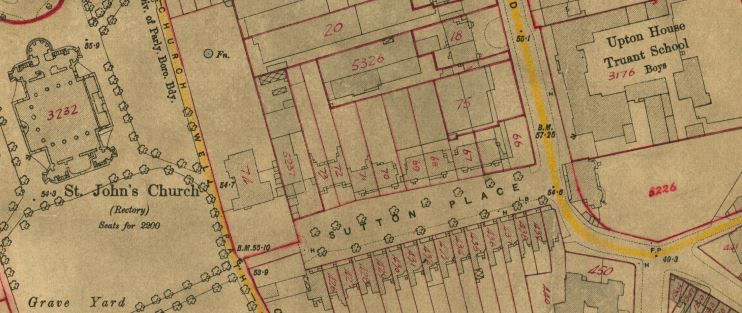
Hackney Valuation Office Maps


This release includes the following areas: Clapton, Dalston, Hackney, Homerton, Hornsey South, Hoxton, Kingsland, Moorfields, South Hackney, Stamford Hill, Stoke Newington and West Hackney.


  • TheGenealogist’s Lloyd George Domesday Survey records zoom down to show individual properties on extremely detailed maps used in 1910-1915
  • Fully searchable by name, county, parish and street
  • The transparency slider reveals a modern street map underlay
  • Change the base map displayed to more clearly understand what the area looks like today


Read about how the Hackney Landowner and Occupier records detail the last days of a Highwayman’s Inn

https://www.thegenealogist.co.uk/featuredarticles/2019/hackney-landowner-and-occupier-records-and-the-highwaymans-inn-1204/


About TheGenealogist


TheGenealogist is an award-winning online family history website, who put a wealth of information at the fingertips of family historians. Their approach is to bring hard to use physical records to life online with easy to use interfaces such as their Tithe and newly released Lloyd George Domesday collections. 

TheGenealogist’s innovative SmartSearch technology links records together to help you find your ancestors more easily. TheGenealogist is one of the leading providers of online family history records. Along with the standard Birth, Marriage, Death and Census records, they also have significant collections of Parish and Nonconformist records, PCC Will Records, Irish Records, Military records, Occupations, Newspaper record collections amongst many others.

TheGenealogist uses the latest technology to help you bring your family history to life. Use TheGenealogist to find your ancestors today!


 About The National Archives

The National Archives is one of the world’s most valuable resources for research and an independent research organisation in its own right. As the official archive and publisher for the UK government, and England and Wales they are the guardians of some of the UK's most iconic national documents, dating back over 1,000 years. Their role is to collect and secure the future of the government record, both digital and physical, to preserve it for generations to come, and to make it as accessible and available as possible. The National Archives brings together the skills and specialisms needed to conserve some of the oldest historic documents as well as leading digital archive practices to manage and preserve government information past, present and future.

http://www.nationalarchives.gov.uk/  http://www.legislation.gov.uk/ 


For the latest stories, follow the Media Team on Twitter @TNAmediaofficer


Leave a comment
Found 8 Results.
Back to top